Welcome to Sophelia's Japan

A blog about adventures, academia, adoption and other things starting with the letter 'A'.
I'm a geek, a metal head, a shiba inu wrangler and a vegetarian, and I write about all of the above. You have been warned!

Smiley hikers

Wednesday, 8 August 2018

Tokyo Medical University Scandal and a Broken Social Contract

No comments:
Image from https://twitter.com/BFJNews/status/1026697347856838656


Even if you don’t usually follow Japanese news, you’ll have no doubt read about the Tokyo Medical University scandal by now. In summary, women were outperforming men on the entrance examination, so the university began docking the scores of all female applicants in order to maintain a male majority in both the program and in the profession. The sexism of all this has quite rightly attracted indignation from around the world. However, I haven’t yet seen anything insightful written about the further ramifications of entrance exam tampering. Not only were all women’s scores reduced, but the scores of some male candidates were inflated in exchange for (or the anticipation of) monetary donations from their parents. Men who had failed the test and returned to try again the following year had their scores decreased.

Sexism is par for the course in Japan, sadly. I think if the case only involved women facing higher hurdles to enter medicine the outrage would blow over fairly quickly. What will not blow over is the knowledge that entrance examinations are not the objective measure the social contract requires them to be. That is earth shattering.

In order to pass entrance examinations, children and young people attend cram schools (juku) or other forms of tutoring. It’s a sector worth tens of billions of US dollars. Families make enormous sacrifices to pay for it. A teacher I worked with estimated that it cost her about US$400,000 to get her son through the exams for a mid-level university (starting from elementary school). When I went to register my pregnancy at city hall I was given an information booklet about creating a savings plan for the foetus’s juku. Family life (and size) is organised around juku. Most middle-class Japanese kids don’t do chores. Their job is to study, and the family does what it has to do in order to support that. It’s kind of the foundation of the later stages of childhood.

Because if you pass the exam to get into a good school and then a good university, you’re set for life.
That’s the deal. That’s the social contract.

Now we know that has been broken.

In some ways, it was the last really strong contract that was left. It used to be, you got a job with a company and you’d be employed for life. You spent all your time working, and moved all over the country away from you family at a week’s notice, but you endured that because you were safe for life. That deal is gone. The top end of the contract was broken and we’ve had decades of upheaval and national soul searching about it.

The bottom end of the same ladder was still strong though, we thought. You might not be employed for life, but if you study hard you can pass the exam. Pass the exam and your status as a graduate from a good school means you will get the best of the jobs that are out there.

The whole ladder is gone now.
Continue Reading...

Sunday, 2 July 2017

Pictures are... Gone.

2 comments:
So Photobucket have suddenly decided they won't allow hotlinking, and have punished me by suspending my account (and locking all my photos) until I pay them a hefty ransom. Which I won't be doing, because I have no money. So... yeah. Screw them. I apologise that most of the pictures on this blog are no longer visible. Realistically I will never have the time to go through, find them all, re-upload them and fix the links. Other bloggers are experiencing the same thing, see:
http://www.hobomama.com/2017/06/photobucket-phail-or-how-to-ruin-hosting-site.html
Most people use Photobucket explicitly for the ability to link from images on Photobucket to other locations such as blogs and forums, so this seems like a baffling move.

Until you realize the scam that's afoot: The only way to get your images to show up again is to pay Photobucket $400, upfront, as an annual subscription to its most expensive plan.

Ah, I see. It's a ransom demand.


Edit: I was given a 12 hour window in which to download my photos. Luckily I saw the email in time (it just arrived, nighttime in Australia) and have been able to recover my pictures. Very relieved.
However, I have to say that I just don't have time to go back through hundreds of pictures and posts to reupload them all for a blog that's essentially no longer active. I'm sorry :(
Continue Reading...

Thursday, 25 May 2017

Over-worked Teachers

1 comment:

A few weeks ago the Asahi Shimbun published an article reporting that public school teachers are now considered at risk of death from over work (karoshi). The article opens with
The minister of education, Hirokazu Matsuno, expressed shock at a survey that shows teachers at public elementary and junior high schools are regularly putting in 11-hour days, placing some at risk of dying from overwork.
The General Union also wrote on the topic recently, pointing out that teachers are not given over-time pay for these hours:
33.5% of teachers in elementary schools and 57.6% in junior high schools perform overtime work for more than 80 hours a month - far beyond the level of recognition of workers' accident.

"Club Activities On Weekends" take an average of 2 hours and 10 minute - almost double that of the 1 hour and 6 minutes from 10 years ago.

The entire document (and its results) can be found (in Japanese) here: http://www.mext.go.jp/b_menu/houdou/29/04/1385174.htm

It's also important to remember that there is no overtime pay for teachers working at public schools.
I don't want to minimise the really awful reality these statistics are revealing. Public school teachers in Japan do work ridiculous hours. However, because I always like to take a slightly different view here (otherwise, why would you bother reading my blog?!), I'm going to point out that in my experience teachers work in ways that are very unproductive and time wasting. This may sound like victim blaming and I hope it will be clear by the end that I am talking about the work systems, not individual practices, so stick with me. Long time readers may remember this post I wrote back in 2012, Teachers Don't Spend a lot of Time Teaching. In it I wrote:
If a teacher wants to make an original worksheet rather than copying one from a resource book, nine times out of ten they will painstakingly draw it up by hand with a pen and a ruler, then photocopy clip art from a book, trim it to the right size and glue it to the worksheet. I had always assumed that this was a result of the pervasive inability to use computers (until two years ago teachers in public JHSs in my city shared one PC per school, and that PC ran Windows ‘95). A fellow ALT one day made a worksheet on his laptop, though, and the teacher asked him to remake it by hand because the computer version was “cold” (impersonal or unfriendly). So it may be that it is a preference and not just technological incompetence. This preference extends beyond schools. I once spent three hours working at the board of education making an index for a big folder of documents. I was given stickers, stamps and ink pad, a cutting board and a box cutter. I had to stamp numbers on either side of the sticker, cut it in half and then match the outer edges neatly while sandwiching the page margin between the inside edges to make an index tag. The kind you can buy in packs of fifty for a dollar that would also look much neater than my ink smudged, crookedly cut ones (but lacking the heartfelt warmth of all the swearing I did while making them). 
 Doing everything in the complicated, inefficient way possible seems to be considered a virtue in the school system, and I think part of the reason is the glorification of overtime hours that extends into Japanese working culture more generally. I'd like to illustrate what I mean with a personal example.
One Wednesday at my then JHS I had an insanely packed schedule. I was at school from 8 for a staff meeting, taught all six periods and marked literally hundreds of test papers in my lunch "break". I was running the whole day, and because my desk was directly in front of the VP's desk I know he saw how hard I was working and how huge the stack of papers I was marking was. I left for the day about fifteen minutes after the end of my official working hours, having been in half an hour early and not had a lunch break. "Must be nice to leave so early" he said.

The next day my naginata club happened to be using the gym at that same JHS for training (we usually used the police dojo but it was temporarily out of action while they tried to recreate the crime scene from an incident with a car driving off the roof of a shopping centre, using tape and cardboard boxes up, true story). Naginata was at 6 but there wasn't any point is going home so once my much less busy day was finished I pulled out my laptop, did some blogging, made a round of coffees for everyone in the staff room, fed the school turtles, and generally bummed around doing nothing in particular. Come 6 I fare-welled the VP as I headed off to the gym and HE said... "Thank you for your hard work today. I'm so impressed." I'd been doing nothing related to my job at all, quite openly too since I was off the clock, and he praised me. The day before I had completed a monumental workload and half killed myself in the process, and he'd had a jab at me. That's what the work culture is like. It doesn't matter if you sleep at your desk half the day, spend another quarter slowly making drip coffee (a favourite past time of many of my JHS colleagues), and do your work halfheartedly for just the remaining quarter. It's the hours you are physically present that count, not what you achieve.
Continue Reading...

Tuesday, 2 May 2017

Life After Institutionalisation

4 comments:
Copyrighted by Human Rights Watch

Tiger was telling me last-night about an orphanage trip to USJ. They'd gone on the Jaws ride, but he didn't know what a shark was so he didn't really understand it. His main impression was that it smelled funny. Despite the well intentioned efforts of the orphanage staff, the system is filled with these strange gaps where things most children simply absorb through daily life remain unknown. At 11:39 in this video a young woman talks about being alone in her apartment after 'graduating' from an orphanage and having no idea how to switch the lights on. In Tiger's orphanage, too, the lights were centrally controlled.

After ageing out of the orphanage system, Japan’s institutionalised children face extraordinary challenges in their adult lives. The 2014 “Without Dreams” report commissioned by Human Rights Watch highlights some of these challenges, including lack of access to higher education, emotional and cognitive development problems resulting from institutionalisation, and lack of basic life skills. The report contains a number of informative vignettes from orphanage graduates with concrete examples of how the lack of preparation and support they received for independent living resulted in homelessness and welfare dependency. These are all issues we were aware of when we became a foster parents, yet awareness of these macro concepts did little to prepare us for the micro-issues that arose on a daily basis when our eight year old son, institutionalised since birth, first came to live with us.

Within an hour of getting home, for example, we discovered that he had never peed in a western-style toilet; the orphanage and his school both had urinals. Having driven to his (few) off-campus excursions in the orphanage bus, he was beyond excited about the power windows in our car. "You push a button and the window opens!" He raved about them to some neighbourhood kids, who laughed at him. He asked our permission to cry when he was hurt or upset, and also before passing gas (I am not sure what he would have done if we’d refused it!). After living in an institution of 100 kids and a large staff, he was terrified of silence, darkness and of being alone for even a few seconds. He woke several times each night, always checking that I was still beside him. He had never been to a friend’s house to play, nor had a friend over. He reflexively called every adult he met “sensei”. He had never been inside a supermarket, bank or post office. The more new experiences we facilitated for him, the more I marvelled at the idea that children growing up in such hermetically sealed environments are expected to find their own way at the ripe old age of 18 (or younger in some cases). As the “Without Dreams” report explains, obtaining a drivers’ license is prohibitively expensive for institutionalised young people, and not having a license limits employment opportunities. This is easy to understand and empathise with. What is harder to understand from the outside is the additional challenge of getting a drivers’ license when you may have had no experience of even being inside a car.


Continue Reading...

Tuesday, 25 April 2017

Habits

4 comments:
Like a fish out of water
I used to think of cultural habits as located in the mind, but since attempting to reintegrate into life in Australia I have found my body far more often than my mind either betraying my acquired foreignness, or reminding me of habits I had never noticed I had before suddenly finding myself practising them again. Bowing is, of course, the quintessential physical habit Japan leavers find ourselves unable to control. After time in Japan bowing becomes so ingrained that even when consciously trying not to it can be impossible to stop. I bow in the car, on the phone, even when writing a particularly formal email. As for the latter category, I sat back inside my mind and watched in fascination as my body of its own accord began shaking out my shoes for spiders before putting them on within just a few days of repatriating. It careful checked towels for spiders before drying me after stepping out of the shower. I must always have done it, I suppose, but unconsciously. I was startled to see people in my home town walking around in the rain without umbrellas. I bought an umbrella and within minutes it was inside out. I had forgotten how windy it is down here, with the roaring forties blowing across the island. I stopped carrying an umbrella, but it felt strange. Foreign.
Continue Reading...

Wednesday, 19 April 2017

Monkey Tourists

No comments:

The past few years have seen some really funny and creative tourism campaigns from Oita, a prefecture mainly known for onsen and monkeys. I never got around to blogging about the international toilet festival, which is a shame because is was amazing... anyway, back to monkeys and onsen. This youtube video did the global rounds at the end of last year:

You can read more about the campaign over at Rocket News. Well, with onsen having been done so heavily in 2016 (there's also some synchronised swimming in onsen here), 2017 campaigns are going to focus on monkeys.


Incidentally Charlotte the monkey, presented as the love interest in this narrative, was named after the UK princess. While it seemed like a good idea initially there was some controversy, with more than a few people suggesting that the royal family might not take it in a flattering light.
Continue Reading...

Saturday, 15 April 2017

Kyushu Quakes, Remembering a Year On

No comments:

Taken from this album 
On Thursday night we had the strongest quake we'd ever felt. Tiger slept right through it, unlike Hayate. We saw on the news the next day that it had originated in Kumamoto and seven or eight people had died. We checked in with our friends in the area, tidied up the spills and went about our business as usual. The next night a magnitude 7, the highest on the Japanese scale, struck. I was sleeping Japanese style with the kids (futons on tatami) downstairs while the husband slept upstairs with the still rattled Hayate.

The quake made an extraordinary sound, like nothing I've ever heard. The closest I can think of is a wave just as it crashes over your head, or the rushing in your ears just before you pass out. As the quake rolled on and on I grabbed the baby and braced myself in the door frame while shouting to Tiger to wake up. Some how neither the quake, my shouting, or the many dogs barking across the neighbourhood woke him. I couldn't leave the doorway with the baby in my arms so I sort of leaned out and grabbed Tiger by his toe (literally) and yanked as hard as I could to pull him to safety. He got a large friction burn from me pulling him across the tatami (tatami burns hurt much more than carpet burns, in my opinion) and then spent days telling people he'd been injured in the quake... technically true but a little misleading.

We were in Japan when 3.11 happened. You don't really get over something like that, and we've always consequently been very conscientious about disaster preparedness. However, we were just weeks away from leaving Japan and there were piles of packing and sorting everywhere. One relief was that I had passed the baton literally two weeks before to the new neighbourhood association rep. I had spent a year as the "information officer in the event of emergencies", meaning in a disaster like this I was supposed to monitor the radio, pass on evacuation information etc to the entire suburb. Why did they entrust a barely literate foreigner with this very language heavy and important role? The short answer is, as with most things, because Japan.* Other responsibilities including taking the role call to ensure everyone in the block I represented was safe, something I was also very glad not to have to do since many of our neighbours had typically Kyushu names, meaning the kanji were read in a totally different way to standard Japanese, and I never completely mastered them all.
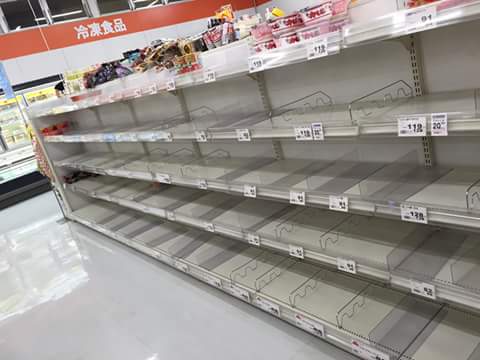
The supermarket shelves were bare, both because of panic buying and because the highway collapse meant the trucks couldn't get through.
Saturday dawned hot and bright, but in a foreboding, over-ripe way. All around the neighbourhood the fledgling birds of spring had been shaken from their nests and their tiny bodies quickly began to rot in the hot sun. A stench hung over everything. Heavy rain and gales were forecast for later in the day, meaning landslides would inevitably follow. With foundations shaken by the quake we felt we were on the brink of an extraordinary disaster, but no one knew quite how big it would be. Tens of thousands of people evacuated. Our neighbours gathered in nervous groups, going from house to house to form consensus in the unobtrusive way of well established neighbourhoods, discussing whether we should leave to. The consensus was no, but fearfully. The neighbourhood association had generators and other emergency supplies on stand by. On TV we saw a university dorm had collapsed, trapping students inside. We watched all day, as hope slowly faded. A fourth year engineering student, a member of the music club, died. A first year student, who had left home just weeks before, died. There were amazing moments of relief, too: A baby girl rescued unharmed from a collapsed house after six agonising hours.

The magnificent castle at Kumamoto we'd visited on our "let's contribute to the local economy" holiday right after 3.11 was terribly damaged, and the highway we would take to the airport when we left had partially been swallowed by the earth.     
Source

We slept in our clothes, torches in hand, and aftershocks rocked us through the night.
Alerts... we didn't get a lot of sleep


*The longer explanation is the the positions are predetermined based on the rotating allocation and the system may not be changed, even for reasons like 'this person is literally incapable of performing the required tasks'. Because Japan.
Continue Reading...

Tuesday, 5 April 2016

Shower Slugs

No comments:
2015 was the worst year for mould yet. Dealing with a little baby and the mould during rainy season was a nightmare, and I was desperate for anything to help. I commented to my sister that it would be great if there were something like aquarium snails that would just hand out in the bathroom eating the mould for me, and she said "maybe there is" and immediately googled this. It sounded good, so we went out to the garden and collected some slugs.


I had bought this mini flower pot as a hide for Tiger's pet snails.


There was plenty of mould for them to feast on :/


They only really took to the grouting, but that's OK, it's the hardest part to clean anyway.


The difference between the slugged side and the not slugged side is pretty amazing. Also amazing: a "gluten free" label on BUBBLE BATH. For all the people with Celiac disease who like to drink soap, I presume.

Sadly the experiment had to be cut short because we had so many textiles go mouldy that the bath had to be used to soak them in very unfriendly solutions for a few weeks so the slugs were evacuated back to the garden. One eventually found its own way back though. It made a little home under a shampoo bottle and sneaks out to help with the cleaning at a leisurely pace.
Continue Reading...

Tuesday, 9 February 2016

Leaving

4 comments:

This is hard to write, but even harder to do. We’re leaving Japan. It was not in our plan, but then, so much that happens in life isn’t that I’m not sure why we bother with plans anyway. We’re here until roughly summer, and after that we’ll be heading to sunny/windy/rainy/snowy Tasmania (you’ll understand if you’ve ever visited Tasmania).
It’s not you Japan, it’s us.
Well, it is a little Japan. Tiger needs a change and he needs some support we can’t afford to provide here. We could have tried to find a solution moving inside Japan, but there are other factors, the main one being an extended family situation I don’t want to go into detail about but which requires our presence ASAP. I have a ton of posts in my head waiting to be written down, so I’ll keep the blog going until they run out and then see where we’re at. I don’t know how well we’ll cope with repatriation. I really don’t.
I’ve spent more of my adult life in Japan than Australia.
We came to this decision (as much as it was in our hands, anyway) at the end of summer. Tiger was away at a camp so we sat down that night to hash out the details. We were fast being confronted with the bottom of our very classy $10 bottle of wine when we heard music that just went on and on. Eventually we decided to go and check it out. I strapped Cricket into the carrier and we headed to the park. It was that bruise-purple light somewhere between dusk and true darkness, and a horde of dragonflies hovered at waist height, as motionless as the humid air. A little girl in a yukata called out that she was going to dance and were we dancing too? An old man in his old-man-uniform of dirty-white vest, waist warmer, and plastic slippers complained that the walk across the park was too far. We all ended up at Tiger’s school, where we realised it was the neighbourhood Bon Odori. We’d been too preoccupied to pay attention to the date. We watched the dancers until the purple turned to black and thought about how much we would miss moments like these.
Continue Reading...

Tuesday, 19 January 2016

Bandaids

No comments:


At the end of a long frazzled day of dragging around town on public transport and a trip to the pediatrician for vaccinations I finally got home and Cricket was desperate for food. I cradled him and he started to nurse furiously only to break away after a few seconds crying. I latched him again, and again, furious nursing before pulling away crying. Tired, frustrated and now covered in leaking milk I was getting increasingly agitated and didn’t notice the father figure getting home. After watching quietly for a minute he suggested “why don’t you try the other side?” I flipped the baby over and he latched on… and his whole body relaxed as he settled in to feed properly. I asked in awe “what made you think of that?” and my lovely husband replied “I saw the bandaid from his shots and figured it might be painful to hold him with his weight on that arm.” I’d completely forgotten about the injection. Parenting Tiger is a lot like this, except he doesn’t have bandaids to helpfully warn us of sore spots. I was rushing to try and bring a load of laundry in before the clouds burst and dumped their rain down when Tiger came home from school and demanded toast. I toasted bread and dumped it on the table with a knife and the peanut butter jar then ran back outside. Cue much dramatic whining about how if I really loved him I’d spread the toast, everyone else IN THE WORLD gets their toast spread for them, and how much he hated me. As I dumped an armful of laundry and prepared to lecture him for being selfish and spoiled something about the sad way he was slumped at the kotatsu made me pause. “Have you ever spread toast before?” I asked, and learned that no, he never had, and he felt embarrassed to say so and frustrated because he was hungry. Instead of a fight we ended up having a lovely afternoon practicing on endless reams of toast. All too often, though, I miss the signs and fight when I should be nurturing. If only there were bandaids to warn me.
Continue Reading...

Sunday, 10 January 2016

I Wish My Baby Would Read

No comments:
Too busy for sleep
I bought a number of useful and authoritative sounding books on baby care, but Cricket just won’t seem to read them. Nor will he listen to professional advice; after he was born I was sternly entreated to burp him after every feed, but he steadfastly refused to produce a single burp. He was passed from nurse to nurse and patted until I feared bruises would result, but no burp made its way out of his little mouth. It did leave him with the rather adorable habit of patting my back in return whenever I put him on my shoulder though. A few days after we came home the baby’s father commented “he doesn’t seem to know how to baby.” It’s true. He never sleeps. Not naps, not at night, never. “Baby should be napping for several hours a day” I read aloud, pausing to glare pointedly at my not-remotely-sleepy-seeming infant. He replies with a gargle and a spit bubble. I hold Super Nanny’s book open to the “suggested sleeping schedule” and wave it in front of Cricket’s face. He tries to eat the book. “Sleep when your baby sleeps” the books all say. I search the index frantically for “my baby never sleeps” but there are no entries. My baby clearly doesn’t know how to baby. His teeth come in and I am terrified he’ll bite my nipple. “Don’t worry” says every source, book and digital, “babies almost never bite.” He bites me. “If they do, it’s almost always a harmless nip of exploration” says every source the baby has clearly never read. Two little holes in my nipple drip blood onto the page explaining how this will totally not happen. My baby doesn’t know how to baby. He ignores the sippy cup I buy and drinks confidently from a glass at three months. He tries to steal food from my plate, spoon, cup and on one occasion my mouth from three months. I print out articles about “virgin gut” and delayed introduction of solids and leave them pointedly lying around, but he persists, screaming for food. I cave and give him sneaky food at four months, but it isn’t good enough, he wants to sit at the table and eat exactly what I’m eating. Cricket’s father entertains his co-workers with photographs of our six month old eating French toast, a whole banana, and lentil stew. He figures out he can make the dogs go crazy by throwing bits of his food to them, and uses his powers for evil. I wake in the middle of the night to find Cricket, seven months, standing next to a large box experimenting with ways to open and close the lid.  I take him to the city playroom and he immediately climbs onto the roof of the play house. He can’t walk, but he climbs like a cat. At eight months the books say he’ll probably drop one nap. “HA” I laugh, my baby doesn’t have a nap to drop! And then he starts napping twice a day, just when other babies are apparently waking up. My baby hasn’t read the manuals. He doesn’t know how to baby.
Continue Reading...