A blog about adventures, academia, adoption and other things starting with the letter 'A'. I'm a geek, a metal head, a shiba inu wrangler and a vegetarian, and I write about all of the above. You have been warned!
If you know what naginata is, your image is probably reflected in this photo:
Strong, fierce women in hakama going at it with big biff-sticks
My experiences with naginata have looked more like... this.
"Don't cry baby, Mummy will be right back after she finishes her biff session"
Although it was not originally a woman’s weapon, naginata
came to be associated almost exclusively with women (warrior monks also used
naginata) during the Edo era. A naginata was part of a samurai woman’s dowry,
and in the militaristic pre-war period naginata was taught as part of PE
classes at girls’ schools. Outside Japan naginata seems to be practiced by
slightly more men than women, but in Japan it is still very much a
woman-dominated sport. I recently participated in the prefectural tournament
and there were only two men competing. The scarcity is reflected in the
newspaper article below. Men and foreigners are pretty much as rare as
one-another.
Yup, that's me, being all perceptibly foreign
The difference in atmosphere between naginata and other martial sports
like kendo or karate is profound. At tournaments there are always a gaggle of small
children running around.
How cute is it that this club made their t-shirts in kids' sizes as well?!
Babies are passed from one set of available arms to another.
I spent about an hour last year watching a baby… I still have no idea who her
mother was. It wasn’t the woman who gave her to me, or the woman I eventually
passed her to when my turn came to compete.
The woman on the right is grandmother to both the national champion and six or seven other high ranking naginata ladies
These dads came along to cheer on their wives, who were both
competing while pregnant. Guess they missed out on that “Asian husbands are evil” memo too.
They are total sweet-hearts with kick-arse wives and cute kids
Helping out a team member who battled through morning sickness (and a small earthquake) to win all of her matches
I’ve been an absolutely terrible team member, taking off
months at a time to work on my MA, move house, and so on. I’ve never been made
to feel bad about missing practice. My teacher said once “it can’t be helped in
a women’s sport. Women are so much busier than men.” I thought it was an
interesting point and I wonder if it’s a common stereo-type in Japan. Most of
the older women I know work at least part-time, but even the ones who work full
time are responsible for all the house work, as well as the community volunteer
activities like neighbourhood associations. One of the women at my club is a
full time teacher, PTA member and regular volunteer at international events but
still has to cook a full meal for her husband every night and make sure his
laundry is done. He, on the other hand, just… works. Women of her generation
(much like my own mother, it certainly isn’t an exclusively Japanese
phenomenon) were caught in the double-burden of job opportunities opening up
for women and an expectation for women to work, without a matching expectation
for men to take on more domestic work. This is not a marriage dynamic I see in
any friends my own age in Japan or otherwise. Still, the point that women have more
demands on their time than men means that there is less pressure than I
expected to contribute to my naginata club.
Finally, naginata is great for kids. Don't you wish this had been a school sport when you were seven?!
The little one on the left was actually six, that's her big sister helping her with her helmet
Don't be fooled by the cute smiles, all three of these girls out-rank me by four belts
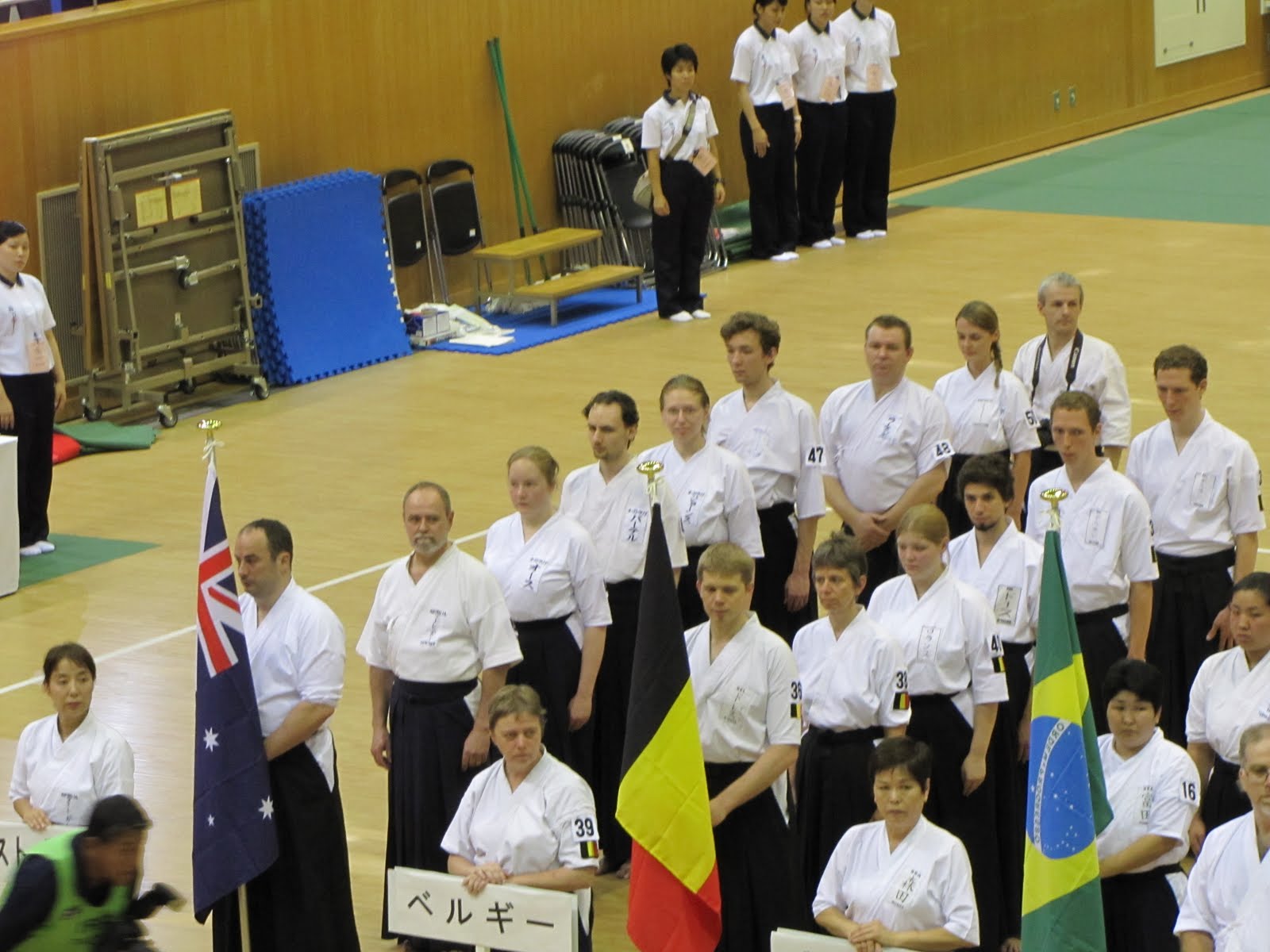
The 5th World Naginata Championship was held in Japan in 2011 and I went to watch and support the Oita girls who were on the national team. My club had planned to go in force to
support the Oita girls who were representing Japan (the
engi^ team). In the end there was too much dilly-dallying and we missed
the window for making group plans, so I went by myself and met up with the others who made it at the championship. The contest was held in Himeji, famous for a really
beautiful castle. Unfortunately for the poor international contestants
the castle was undergoing renovations! I visited the castle back in 2005
so it wasn’t a problem for me and I didn’t have time for sightseeing
anyway.
There were a few performances by local school children. The high school girls' rhythm naginata display was beautiful.
It was really interesting seeing the
behaviour of everyone at the Championship. I’ve spent enough time in
Japan now that I had forgotten how intense things are for people outside
Japan who are into Japanese stuff. Many of the contestants were
obviously really into Japanese martial arts in the almost reverent way I
remember from my Aikido days. I feel so differently about it after
watching the school tournaments and so on, it was both nostalgic and (at
the risk of being mean) a bit funny. For example, at the start of the
opening ceremony all the contestants were lining up very seriously,
often bowing as they came into the hall. The announcer told them to
begin the parade and then the theme from Rocky started to play. So much
for the “sacred space for the cultivation of a warrior spirit”
pretentiousness! On the other hand, I got really irritated with the
Japanese crowd. The difference in the level between the Japanese
contestants and most of the other countries’ contestants was huge, and
the people around me kept saying things like “after-all, foreigners just
don’t understand Japanese martial arts” and “they are bigger and
stronger but they can’t match us for skill”. There’s an obsession here
with viewing everything through an ethnic/racial prism (I know it
happens everywhere, but for obvious reasons I am more aware of it in
Japan). It didn’t occur to them that the Japanese representatives have
been doing naginata since kindergarten while most people from other
countries probably started in their 20s or even later. It didn’t
occur to them that naginata is so obscure that there are not many high
ranked teachers in other countries and less overall talent to draw from.
They were also laughing at some of the representatives for wearing
kendo armour not naginata armour. They have no idea how expensive and
difficult to find that kind of stuff is overseas, it’s so normal for
them. I felt especially bad when a contestant’s armour came loose and
the referee stopped the match so he could fix it. He started to retie it
but he was facing the wrong way. The referee expressed disapproval but
didn’t indicate what he was supposed to be doing. He kept swivelling
around trying to figure out what he was meant to be doing with no-one
helping him and the crowd laughing uproariously. That was a low point,
but overall it was a fun day. An American name Kevin caught the
fancy of the crowd and he got lots of cheers.
The UK team only had three
members and one fainted during the opening ceremony, so Australia beat
them to a pulp and that’s all that really matters ;) If I’m in a
financial situation to join the next one (it’s held every four years) I
definitely will. I would be decimated in the actual fighting section but
my engi^ is as good as many of the representatives. I’m also
much more modest, of course. And, you know, I have the tiny advantage of training with the all-Japan champion (and her grandmother).
Supporting our girls!
Australia's Team
This is the Swedish engi team. In case you couldn't guess.
^In
an engi match two people “fight” according to a predetermined sequence.
Multiple pairs perform the same routine and the judges award the
“match” to the pair who performed the moves best.




 Posts
Posts

